Breast augmentation continues to be the most common plastic surgery procedure in the U.S. Because of this, the frequency of patients that decide to revise their breast augmentation is also common.
Who Needs a Breast Revision?
Women who decide to have breast implant revision may do so for a variety of different reasons including:
- implant size too big or too small or asymmetric
- breast implant pocket asymmetry
- capsule contracture
- desire for different type of implant
- request for a new implant
What is Breast Revision?
There are a variety of terms for the various types of breast implant revision surgeries including:
- implant exchange
- implant removal/explantation
- capsulectomy (removal of capsule)
- capsulorrhaphy (repair of capsule)

Can a Breast Revision Be Combined With Other Procedures?
In addition to these individual implant revision procedures, some patients also require or benefit from breast tissue shaping procedures such as:
- breast reduction
- breast lift
- breast fat transfer
The combination of all of these procedures allows modification and improvement of just about every kind of breast shape issue.
During your consultation with board-certified plastic surgeon Dr. Repta, you will discuss your prior breast augmentation history, breast health history, goals for breast revision surgery, as well as your options and plan of breast revision surgery.
Breast Revision
Before & After
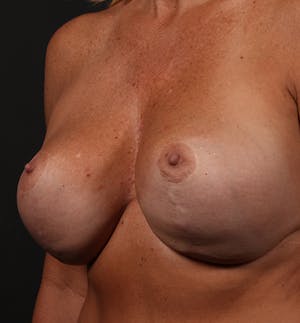
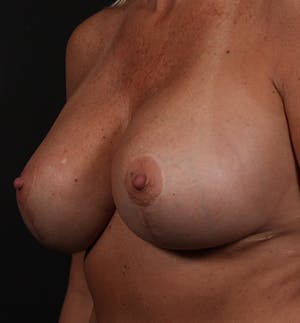
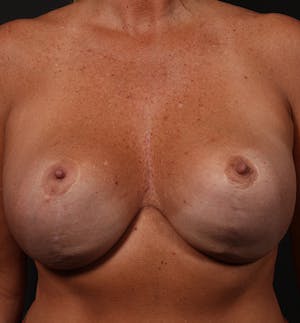
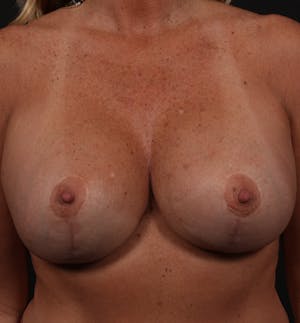
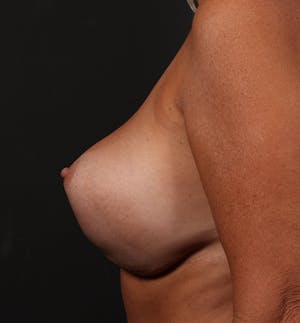
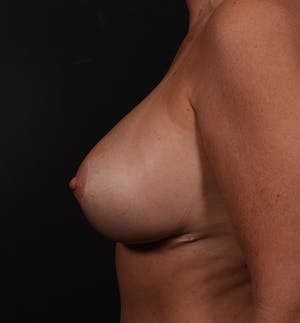
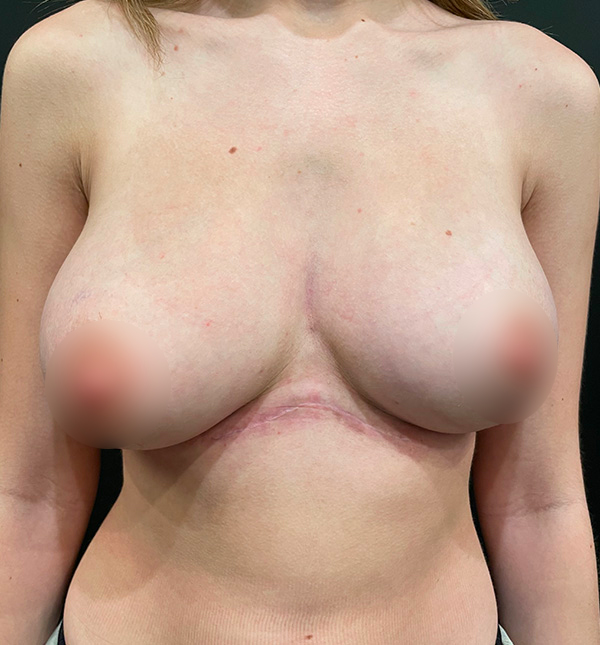
This patient had undergone a breast augmentation and breast lift by another surgeon. Unfortunately the result was not what the patient wanted including the implants ‘bottoming out’ where they sit below the breast fold, poor breast lift incision scars, and breast implant size that was too wide for her chest width. To correct these issues we performed a breast revision with narrower implants, a pocket repair also known as a capsulorrhaphy, and a breast lift revision. She is shown here six months after her surgery.
A Word From Dr. Repta
Breast Revision
Breast revision surgery encompasses many different type of procedures for various breast shape and breast health problems.
Patients with the following breast problems may be a candidate for breast revision surgery:
- Breast Lift
- Breast lift asymmetry
- Breast lift scarring
- Breast lift shape
- Breast augmentation
- Breast augmentation asymmetry
- Breast augmentation size issues, including being too big or too small
- Breast augmentation cleavage issues, including not enough cleavage or too much cleavage, including symmastia (uni-boob)
- Breast augmentation bottom out
- Breast augmentation pain
- Breast augmentation hardness or firmness
- Breast Reconstruction
- Breast reconstruction shape
- Breast reconstruction size
- Breast reconstruction pain
- Breast reconstruction failure (loss of implants)
Breast revision surgery is the process of figuring out what the issue or issues are and understanding what the patient is ideally trying to accomplish and then generating a plan that best meets those needs. This can and does often involve addressing various aspects of breast shape and health including:
- Breast scars
- Breast position
- Breast size
- Breast implant size, width, height, shape, and position
- Removal of breast capsule
- Tightening of breast pocket
- Loosening of breast pocket
- Assessing areola shape, size, and position
What is Symmastia?
Congenital symmastia is a genetic/anatomic development issue where there is no distinct separation of the breasts in the midline overlying the sternum or breastbone. Patients with congenital symmastia do not have any or have very little cleavage. The condition is usually made worse when the breasts are pushed together such as with a push up bra. The source of congenital symmastia is not completely understood but it is related to how that area of the chest develops in some individuals. It frequently involves excess of tissue over the sternum, weakly attached skin overlying the sternum, as well as a wide breast base.
There is another type of symmastia that is surgical symmastia. Patients in this category also have little or no cleavage but the cause of the symmastia for these patients is the placement of their breast implants. If the implants are too wide and or the pockets created are made too big toward the midline, the implants can migrate toward the center and the skin overlying the sternum can raise up creating what is sometimes called a “uni-boob”.
Understanding Surgical and Congenital Symmastia Repair
Repair of surgical symmastia is accomplished by repairing the breast implant pockets which is called capsulorrhaphy. Sometimes mesh or ADM may be used to accomplish this, but often just sutures will be sufficient. It is important to make sure that the implants are not too wide as too wide of an implant will stress the repair and may re-create the surgical symmastia.
Congenital symmastia repair, on the other hand, does not involve pocket repair since by definition this type of symmastia developed naturally not as a result of implants. Congenital symmastia repair involves managing the breast tissue near the cleavage lines and addressing the skin attachment over the sternum.
How do you fix symmastia?
In most cases, surgery will correct symmastia. This may involve:
- Removing the implants and replacing them with new, usually smaller implants
- Reattaching the skin that has detached from the sternum using internal stitches
- Adjusting the pockets of tissue in the chest that hold the implants in place
- Reinforcing pocket boundaries using a dermal matrix or mesh
- Removing the implants and replacing them with transplanted tissue flaps from another location on your body
Congenital symmastia
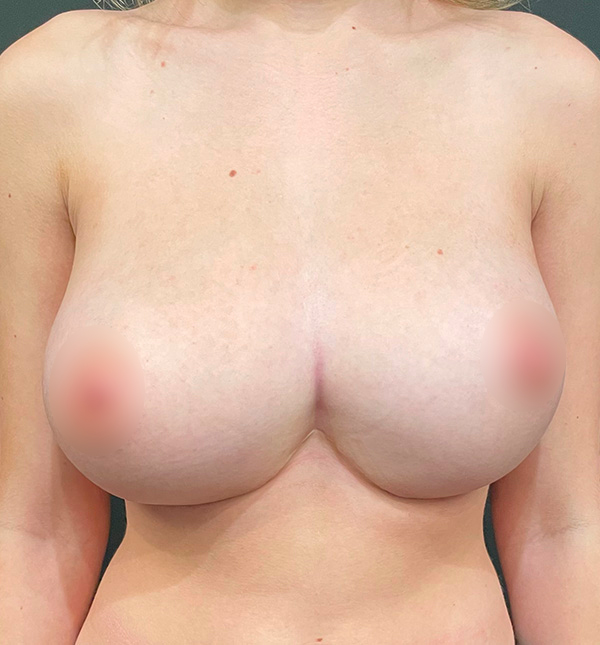
Congenital symmastia is less common and occurs when patients are born with breasts that are too close together. There is no distinct boundary between the breasts, so the breasts are joined in the middle where a natural cleavage area should exist and one breast blends into the other.
It’s possible to treat congenital symmastia by addressing the structure and size of the breasts, providing a natural separation and enhanced cleavage. We may accomplish this with a three-step process:
- Liposuction between the breasts to remove a small amount of breast tissue
- Surgically reattaching the skin at the cleavage area to the breastbone
- Compress the site to help the skin and chest wall heal
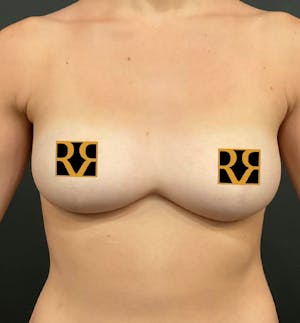
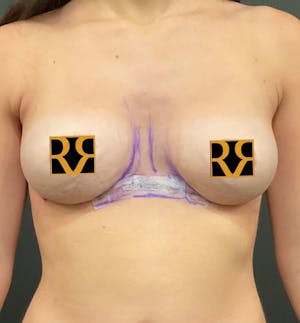
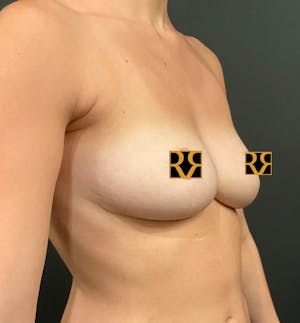
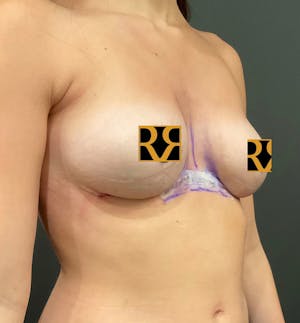
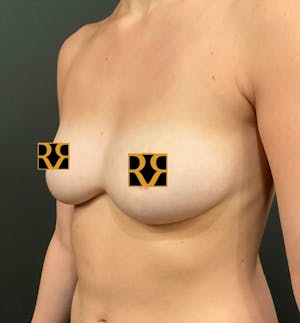
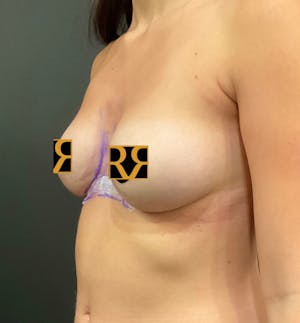
Congenital Symmastia
Before & After
This wonderful patient is shown here before and after her congenital symmastia repair. She consulted with 25 other plastic surgeons prior to Dr. Repta and was told that it could not be fixed. Using a technique that he developed, Dr. Repta was able to fully correct her congenital symmastia. She is shown here just past two weeks after her surgery, illustrating that the symmastia is corrected and the cleavage and breast shape has been improved.