Breast augmentation is the most common plastic surgery procedure in the country, followed by rhinoplasty (nose job). Although breast augmentation may go by many different names, including breast implants, breast enhancement, and boob job, it all means the same thing: to increase the volume and improve the shape of the breast.
At Repta Plastic Surgery in Scottsdale, Arizona, Dr. Remus Repta is recognized for his precision and artistry in aesthetic surgery. As a board-certified plastic surgeon, he takes a collaborative approach, working closely with each patient to create a surgical plan that reflects their vision. This partnership ensures results that feel true to your desired look.

What Is Breast Augmentation?
There are two main ways to increase the size and volume of a breast:
- Using breast implants
- Using your own fat
Breast augmentation with fat transfer is a process where fat is removed via liposuction from areas where there is excess fat. The fat is then placed into the breasts.
The main limitations of fat transfer breast augmentation are having enough fat and getting more than about one cup size increase in breast size in one fat transfer session. The benefit of fat transfer is not having a foreign implant and having completely natural-feeling breasts.
By far the most common type of breast augmentation is breast augmentation using an implant. Using an implant for breast augmentation allows the surgeon and patient to achieve nearly any size and shape of breast desired in one procedure.
Although there is a ton of information related to breast implant augmentation, Dr. Repta feels there are four main points of discussion to determine the ideal breast augmentation plan for each patient:
- Breast implant size
- Breast implant type
- Under or over the muscle
- Incision used for placing the implant
Breast Implant Size
This is perhaps the most important part of the breast augmentation decision process. Obviously, if there is an ideal breast cup size or volume that you want and the final result ends up being too small or too big, you won’t be satisfied.
To make sure we find the ideal volume, we do a mathematical estimation and use a sizer in the pre-operative meeting with you. We’ll ask you to bring in a sports bra that fits the cup size you desire. Using a variety of sizer implants in the office setting allows you to fine-tune your ideal implant size.
Transaxillary/Endoscopic Breast Augmentation
If you’re concerned about having visible scars after your breast augmentation, one possible solution is transaxillary breast augmentation, also known as endoscopic breast augmentation. Unlike standard breast augmentation, the transaxillary technique does not require any incisions around the areola or along the inframammary fold.
Instead, Dr. Repta inserts the breast implants through small incisions located underneath each arm. This procedure offers the same natural-looking results as traditional breast augmentation, but the only scars will be hidden beneath the arms.
During your consultation with Dr. Repta, he will discuss your aesthetic goals and needs to help you determine if transaxillary breast augmentation is your ideal option.
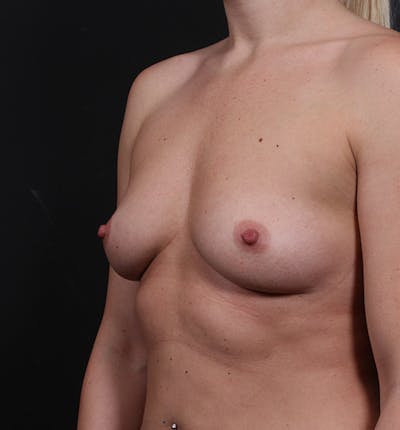
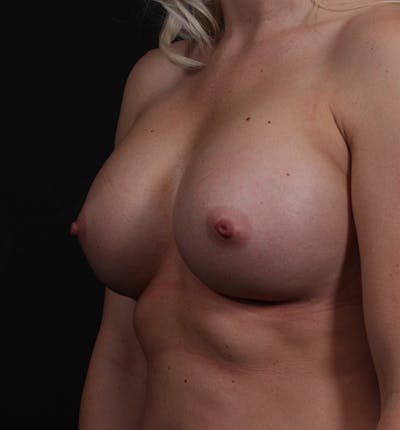
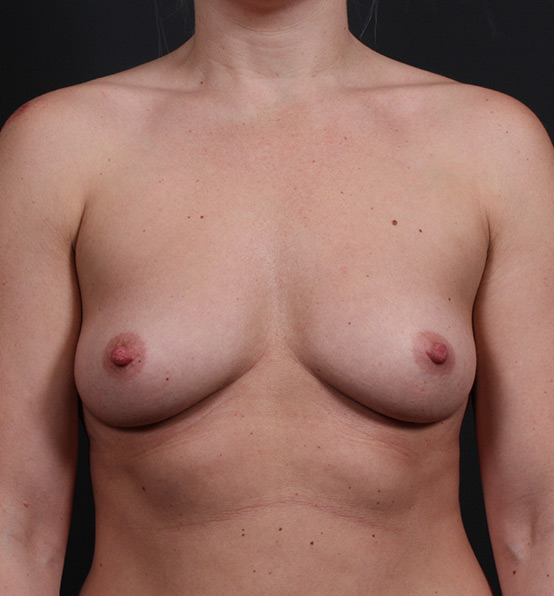
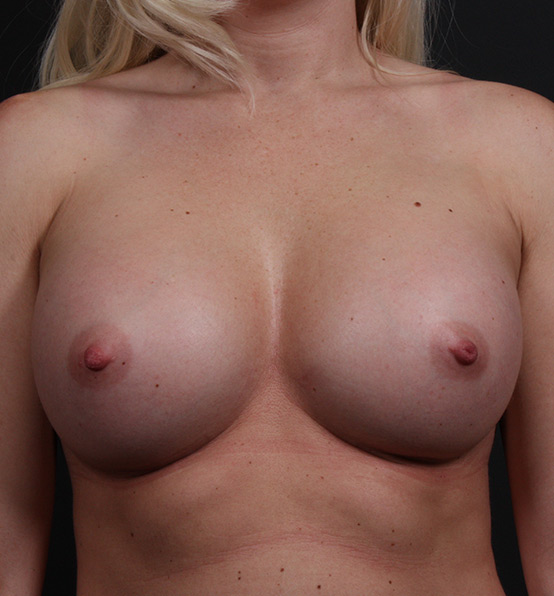
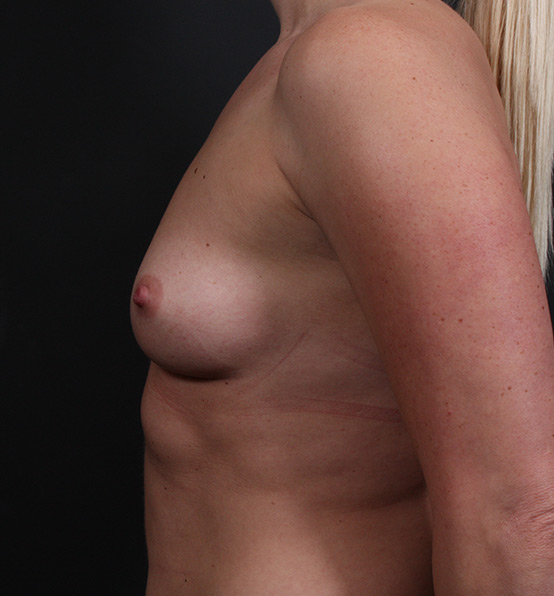
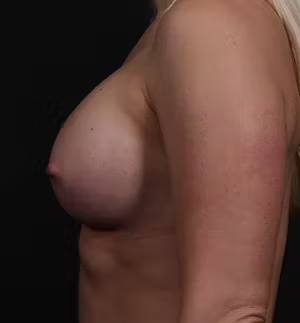
Breast Augmentation
Before & After
This patient, who is in her mid-twenties, desired to improve the shape and fullness of her breasts. We discussed the various options for implants available to her and decided to use 350 cc round silicone implants placed via an incision in her breast fold. She is shown here three months after her surgery with more fullness and improved shape to her breasts with a well-concealed incision in her breast fold.
Breast implant type
There are three main types of implants, and each has its pros and cons:
Saline
Advantages: Lowest cost and smallest incision.
Disadvantages: Least natural feel and look.
Round Silicone
Advantages: Medium cost and incision, and is most applicable to all patient body types.
Disadvantages: Very thin patients may still not have as natural a look as desired.
Shaped Silicone
Advantages: Best suited for thin individuals. Can provide the most natural look and is the least likely to be noticed in terms of where the implant starts/stops.
Disadvantages: Higher cost, greater chance of rotation, and requires a slightly larger incision.
Under or Over the Muscle?
Another decision you’ll make is placing the implant under or over your pectoralis muscle. In general, here’s what we recommend:
- Patients who are athletes and do not want to have the pectoralis muscle cut or impacted should choose to place their implants on top of the muscle, either subglandular or subfascial.
- Patients who are thin should go under the muscle.
- Patients who have a lot of breast tissue laxity from either pregnancy or weight loss should also go under the muscle.
Everyone else essentially is a candidate based on preferences. One caveat is that saline implants should always go under the muscle because of the characteristics of the saline implant.
Incision Location to Place the Implant
The most common incision location used for breast augmentation is a breast fold incision. This is the most common incision location regardless of breast implant type. This incision location affords Dr. Repta the most control in designing the breast implant pocket.
Other incision options include at the border of the areola and through the armpit. The belly button is also an option, but this is rarely used anymore. A shaped implant has to go through the breast fold incision since it has to be placed in a specific position.
A few other bits of information for breast augmentation:
- Implants do not have to be replaced at any given time. If you like how they look and feel, then you are good to go.
- Implants have a lifetime warranty for defects.
- The FDA recommends an MRI every two years for silicone implants. The reality is that virtually no one does this.
- Mammograms are not affected by breast implants.
- Silicone is completely inert and safe.
Dr. Remus Repta
Excellence

Meet Dr. Remus Repta
Dr. Remus Repta is a board-certified plastic surgeon in Scottsdale who has garnered a reputation for excellence in breast augmentation surgery. He employs the most advanced techniques with precision and a focus on achieving the aesthetic ideal for each patient he treats.
Over the years, the surgical approach for breast augmentation has advanced, and Dr. Repta develops a customized treatment plan for each patient, working closely with them to ensure they achieve their personal vision in the most natural-looking way.
For an exceptional patient experience and beautiful results, connect with one of the best plastic surgeons for breast augmentation in Scottsdale, Dr. Remus Repta.







Frequently Asked Questions
Book Your Private Consultation
Our Scottsdale practice proudly welcomes patients from Mesa, Gilbert, Chandler, Paradise Valley, and surrounding communities seeking personalized treatment and exceptional aesthetic care.
If you’re considering breast augmentation, it’s incredibly important to work with a board-certified plastic surgeon who can help you determine what you want and guide you.
In a private, comfortable consultation, Dr. Repta will inform you on implant types and sizes in order to help you make decisions. He will go over your areas of concern, questions, and goals to select exactly the right method and technique for your procedure. To set up your consultation, we invite you to reach out to us today.
Schedule your private consultation by calling our office today at 855-377-3782.